

Slack alerts
Create a Slack Incoming Webhook, connect it in BooleanSMTP, send a test alert, and fix the most common errors.
BooleanSMTP posts a Slack message the moment an outgoing email finally fails to send. Setup uses a Slack Incoming Webhook you create yourself — BooleanSMTP only ever sees the webhook URL you paste in.
Create a Slack Incoming Webhook
Section titled “Create a Slack Incoming Webhook”- In Slack, add the Incoming Webhooks app to your workspace (Apps → search “Incoming WebHooks” → Add to Slack).
- Choose the channel alerts should post into, then add the integration.
- Slack shows you a Webhook URL that looks like
https://hooks.slack.com/services/T00000000/B00000000/XXXXXXXXXXXXXXXXXXXXXXXX. Copy it. Anyone with this URL can post messages into that channel, so keep it private.
Connect Slack in BooleanSMTP
Section titled “Connect Slack in BooleanSMTP”- In the BooleanSMTP sidebar, click Alerts.
- Under Available Providers, click the Slack card.
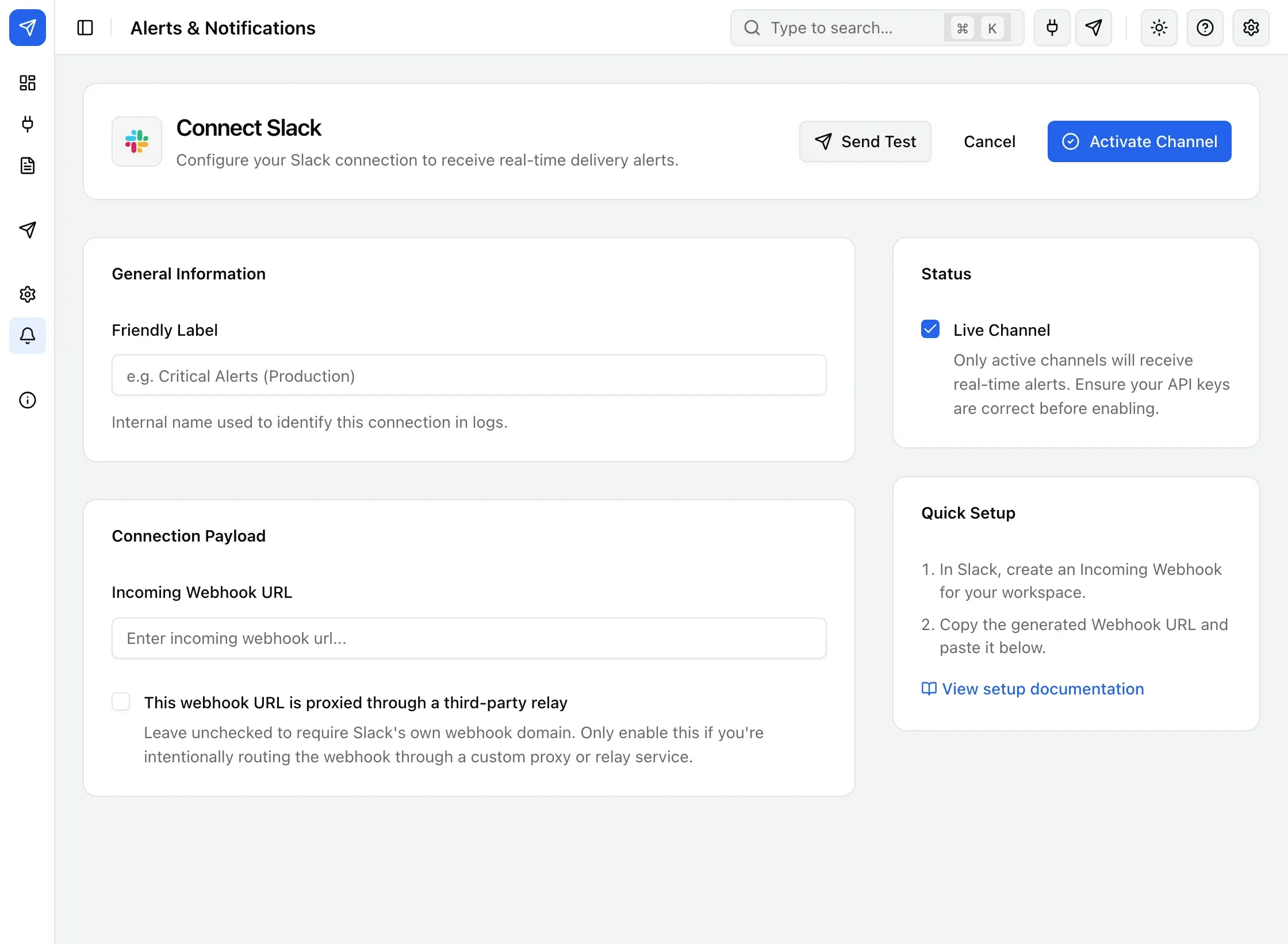
- In Friendly Label, enter a name for this channel (for example “Ops Slack”).
- In Incoming Webhook URL, paste the URL you copied.
- Leave This webhook URL is proxied through a third-party relay unchecked, unless you are intentionally routing the
webhook through your own proxy instead of pointing straight at Slack. Checking it accepts any HTTPS URL instead of just
hooks.slack.com.
Send a test alert
Section titled “Send a test alert”- Toggle Live Channel on. BooleanSMTP does not send real alerts through a channel that is off.
- Click Send Test. BooleanSMTP posts a real message to Slack using the values currently in the form.
- Click Activate Channel to save.
A failed test shows Slack’s own error text, not just “failed” — see below for what the common ones mean.
Common errors
Section titled “Common errors”“Slack Webhook URL is required.” — the Incoming Webhook URL field is empty.
“This does not look like a Slack webhook URL.” — the URL doesn’t match Slack’s webhook shape. Check you copied the full URL Slack generated, not a different service’s webhook — or check This webhook URL is proxied through a third-party relay if you’re intentionally using a proxy.
“channel_not_found” — the webhook was deleted, or its channel was removed. Create a new Incoming Webhook and update the URL here.
“channel_is_archived” — the destination channel was archived in Slack. Unarchive it, or create a new webhook pointing at an active channel.
A rate-limit message — Slack is rate-limiting this webhook. This is rare for normal alert volume; if you see it often, several sites are likely sharing one webhook — create a separate webhook per site.
Send Test worked, but no alerts arrive — confirm Live Channel is on and the channel was saved with Activate Channel (or Update Channel), not left unsaved in the form.
Alerts arrive in the wrong channel — the webhook URL fixes the destination channel in Slack; there’s no separate channel selector in BooleanSMTP. Create a new webhook against the right channel and update the URL here.
See also: Alerts, Discord alerts, Telegram alerts.